Why don't you use WhatsApp?
# “Why don’t you use WhatsApp?”
The short answer is privacy.
I should be upfront: I do still have a WhatsApp account. Kids’ sports teams use it to coordinate with parents, and I check those groups when necessary. The app is hidden from my phone’s home screen, notifications are off, and WhatsApp does not have access to my contacts. Please do not rely on me seeing a message there. Signal or email are much better ways to reach me.
# The longer answer
Following WhatsApp’s January 2021 privacy-policy update, I switched to Signal once it became clearer how much user data Meta would share across its services.
The 2021 update did not mean WhatsApp could read your encrypted message contents. It did clarify that WhatsApp collects and shares extensive metadata and business-interaction data with Meta, increasing the risk that personal information tied to your account (phone number, device info, contacts list, usage patterns, IP address, profile details, and business-chat data) can be used across Meta’s advertising and product ecosystem. WhatsApp’s own follow-up post stressed that end-to-end encryption for personal chats was unchanged; reading the updated policy is what prompted my move, not rumour.
# What end-to-end encryption covers and what it does not
WhatsApp uses the Signal protocol for end-to-end encryption of message contents, so messages between senders and recipients are encrypted in transit and not readable by WhatsApp itself. The policy changes that prompted my move did not claim to break that encryption for standard chats, but they did expand what non-message data WhatsApp could surface to Meta, and how business messages and integrations might expose inputs to Meta systems. That blur between protected message content and broadly collected metadata created a privacy model I was not comfortable with. Wikipedia’s summary of the reception to WhatsApp’s security and privacy features is a useful overview if you want the broader history.
# Why metadata matters
Even when message text is encrypted, metadata (who you message, when, how frequently, group membership, phone numbers, profile picture, and IP or device data) can be extremely revealing. Metadata can be used to build behavioural profiles, target advertising, and infer relationships or routines. Because Meta’s business model depends heavily on data-driven targeting across its services, allowing WhatsApp to share metadata with Meta gives the company leverage it can use beyond the chat app itself. That is a core reason to prefer a service whose design minimises metadata collection and sharing. The Guardian’s piece from the time explains this well for a general audience.
# Business integrations, AI features, and additional exposure
WhatsApp’s evolving features, such as business messaging, cloud backups, and integrations with Meta’s AI and business tools, create additional vectors where inputs and attachments can be stored or processed outside end-to-end-encrypted channels. Where messages interact with business systems or cloud services, those interactions may be logged or exposed in ways that standard peer-to-peer encrypted chats are not. That further reduces the practical privacy guarantees for many real-world uses. Georgetown Law Tech Review’s analysis discusses how users interpreted, and sometimes misinterpreted, the 2021 changes.
# Why I chose Signal
Signal is architected to reduce both content and metadata exposure. It minimises the information it holds about users (for example, it does not retain contact lists or detailed metadata), defaults to privacy-preserving options, and is governed by an independent non-profit rather than an advertising-driven corporation. For me, that means fewer ways my family’s and my contacts’ data can be stitched into a broader profiling system. You can download Signal or message me there if you would like to stay in touch that way. I donate to Signal and encourage others to do the same. Donations help pay for the servers and ongoing development that keep Signal independent, with no ads and no surveillance business model.
# Meta’s broader data practices
Meta’s products (Facebook, Instagram, WhatsApp) increasingly operate as a single ecosystem for data: cross-platform sign-ins, ad targeting, and shared infrastructure mean data collected in one product can influence experiences in another. If you are trying to limit how much a single company can assemble about you, avoiding that entire ecosystem reduces the surface area for behavioural tracking and targeted profiling. That is why I do not use Facebook or Instagram either. I wrote about my beef with Facebook back in 2011; the incentives have not improved since.
# Practical considerations
Kids’ sport runs on WhatsApp. Training times, game-day changes, and car-pool arrangements live in parents’ group chats, and that is where the organisers already are. I am not willing to miss something our children need me to know because I have principles about messaging apps.
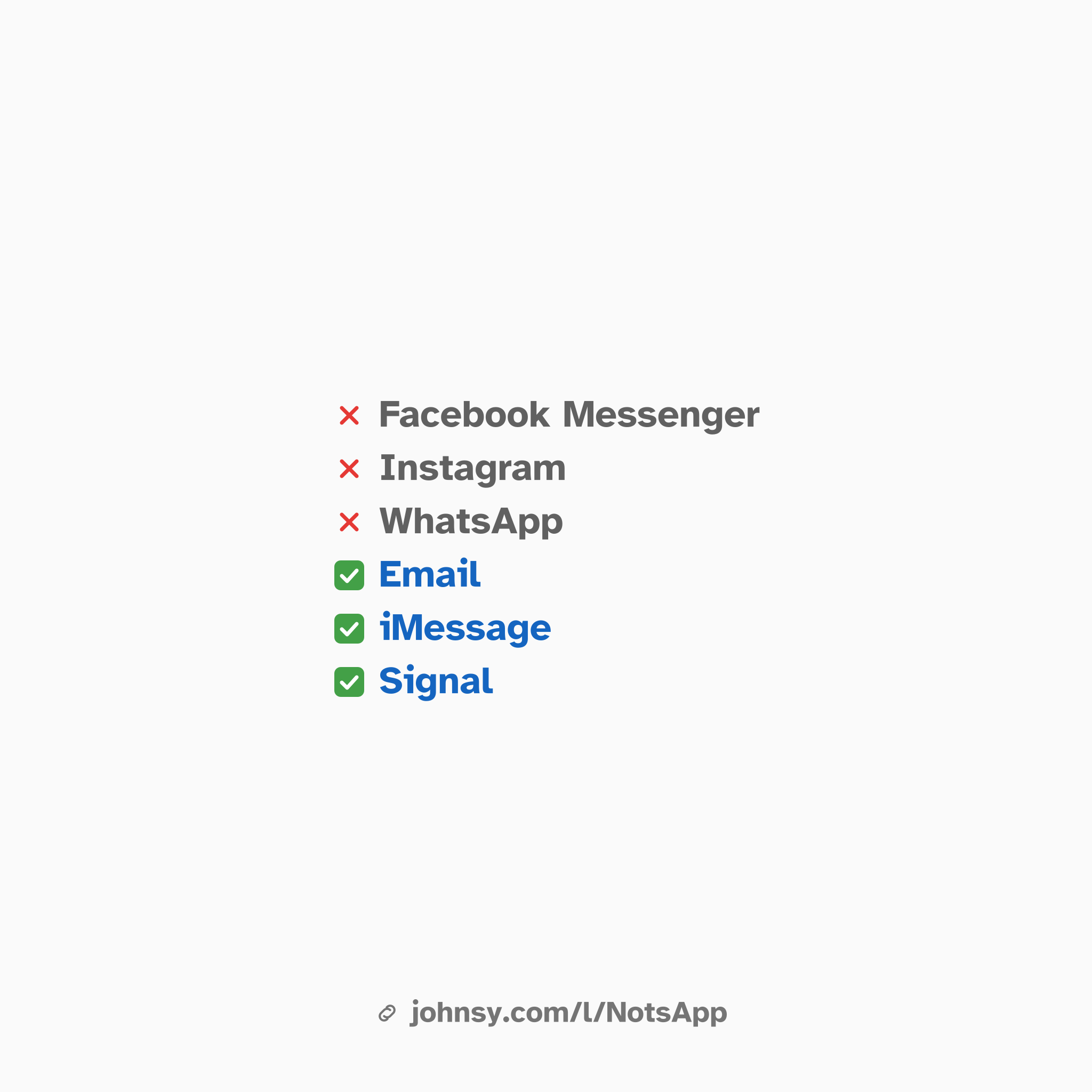
So I compromise rather than quit entirely. I keep WhatsApp for those logistics groups only, check them when I need to, and treat the account as single-purpose. I am clear with people that they should not expect a timely reply there. For anything outside a team broadcast, Signal, iMessage, or email are what I actually read.
Even a minimal account has rough edges. I avoid cloud backups, business chats, and anything that might copy conversation data outside the default end-to-end-encrypted path. Screenshots and forwarded messages are outside my control once someone else takes them. And like any company, Meta can be compelled to hand over data it holds; giving it less to hold in the first place is the main lever I have.
# In summary
# Further reading
- WhatsApp Security Whitepaper: Signal protocol for end-to-end encryption
- WhatsApp Help Center: Answering your questions about the January 2021 privacy policy update
- WhatsApp Blog: Giving more time for our recent update
- The Guardian: Is it time to leave WhatsApp, and is Signal the answer?
- Reception and criticism of WhatsApp security and privacy features (Wikipedia)
- Georgetown Law Tech Review: A mass exodus from WhatsApp to Signal?